
winter squash (Cucurbita maxima)
Cucurbita maxima is an annual herb that may trail along the ground or climb using tendrils, while some cultivated forms have a bushy habit.
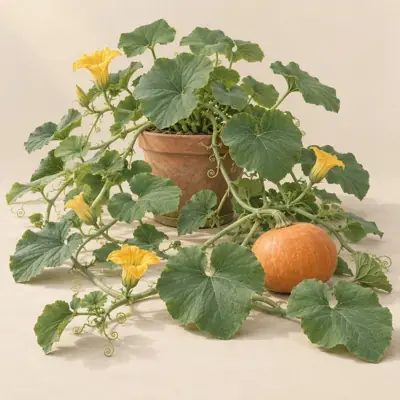
Overview
Cucurbita maxima is an annual herb that may trail along the ground or climb using tendrils, while some cultivated forms have a bushy habit.
Origin and habitat
Sources differ on its origin: wild ancestors are associated mainly with southern South America, especially Argentina and Uruguay, while some accounts place the origin of the cultivated plant in Argentina, Bolivia, or central to southern South America. Cultivated forms occur mainly in managed settings and are widely grown in gardens and agricultural and horticultural environments; sources differ on whether the cultivated plant has wild populations, and it may occasionally escape cultivation. It is suited to warm-temperate to tropical environments with a warm growing season, and sources also describe cultivation in tropical areas below certain elevations.
Characteristics
Sources differ on mature height, placing it at about 10–60 cm, while the few available sources report a mature spread of about 250–400 cm. Growth is rapid, and the large green leaves are nearly round to palmate, usually without conspicuous lobing, and relatively soft; Chinese-language sources also describe rounded leaf tips and an absence of white spots. The unisexual, radially symmetrical flowers are yellow to golden yellow, with relatively small corolla lobes that some sources describe as rounded at the tips or turned outward; flowering is reported to occur in autumn. Fruit varies greatly in form, size, color, and surface, ranging from round to elliptical and including many cultivated forms; colors include pale yellow, orange-red, orange, green, or gray, and the surface may be smooth or ribbed, with some cultivars producing exceptionally massive fruit.
Light
Cucurbita maxima prefers full sun, although some sources indicate that it can also accept bright, light shade.
Watering
Soil should remain moderately moist but well drained; drier, lower-humidity periods are also described as favorable for growth, while foliar diseases occur more readily during wet periods.
Temperature and dormancy
The few available sources report an ideal temperature of about 20–30 °C, with a lower value of about 9 °C and an upper value of about 38 °C.
Growing medium and mounting
It favors fertile, nutrient-rich soil that retains moisture while draining well, including loamy or sandy soil, with preferences and tolerances spanning moderately acidic to moderately alkaline conditions.
Propagation
Propagation is by seed; seeds establish readily in warm soil, and transplanting is described for late spring, early summer, or after the last frost.
Common problems
Potential pests include slugs, snails, and other pests common to cucurbit crops. Possible diseases include powdery mildew, gray mold, cucurbit downy mildew, gummy stem blight, and anthracnose. Foliar diseases occur more readily during wet periods, while vigorous growth and extensive spreading require substantial growing space. As a warm-season plant it is sensitive to low temperatures, which may kill the plant, and it prefers a sheltered environment.
Identification
It is reported to have soft, nearly round stems and soft, nearly cylindrical or spongy fruit stalks that usually lack conspicuous angles and do not enlarge where they join the fruit; the leaves are usually not conspicuously lobed. Fruit is reported to be extremely variable and includes cultivars capable of producing giant fruit.
Photos


Sources
- Wikipedia (en): Cucurbita maxima — CC BY-SA 4.0 · link
- 維基百科:笋瓜 — CC BY-SA 4.0 · link
- Wikipedia (ja): セイヨウカボチャ — CC BY-SA 4.0 · link
- Wikipedia (de): Riesen-Kürbis — CC BY-SA 4.0 · link
- Wikipedia (fr): Potiron — CC BY-SA 4.0 · link
- Wikipedia (es): Cucurbita maxima — CC BY-SA 4.0 · link
- GBIF descriptions: Manual of the Alien Plants of Belgium; Checklist of introduced taxa in Romania; Lista de especies de — per dataset · link
- NC State Plant Toolbox: Cucurbita maxima — copyright (facts only) · link
- Useful Tropical/Temperate Plants: Cucurbita maxima — CC BY-NC-SA 3.0 (facts only) · link
- RHS Plants: Cucurbita maxima — © RHS, facts only · link
- USDA PLANTS Database: Cucurbita maxima — Public domain (US Government work) · link