
glaucous barrel cactus (Ferocactus glaucescens)
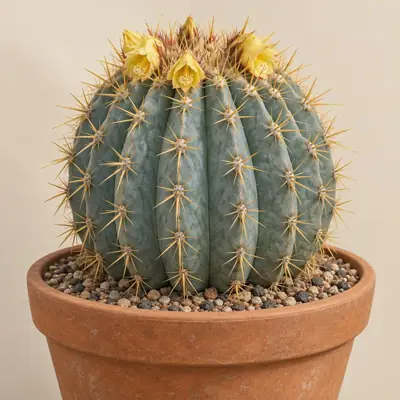
Ferocactus glaucescens is an evergreen perennial barrel-shaped succulent cactus that is usually solitary but may produce basal offsets and form clumps when mature; its stem develops from globular to short-cylindrical.
Overview
Ferocactus glaucescens is an evergreen perennial barrel-shaped succulent cactus that is usually solitary but may produce basal offsets and form clumps when mature; its stem develops from globular to short-cylindrical.
Origin and habitat
Sources differ on its native range, describing it from central to eastern Mexico, with records from Guanajuato, Hidalgo, Querétaro, and San Luis Potosí, while major sources regard it as endemic to Mexico. It occurs in dry deciduous forest and dry scrub, commonly on limestone hills and well-drained rocky or gravelly terrain. Its natural environment is predominantly dry and strongly sunlit, including desert, dry scrub, and dry forest conditions.
Characteristics
Sources differ, placing mature height at about 40–60 cm and mature spread at about 20–60 cm. Growth is slow, especially in the early stages. The flowers are yellow and bell-shaped to funnel-shaped, with sources differing on flowering from late spring through summer. Sources differ in their descriptions of the fleshy fruit; it is generally described as globose, white to yellowish white and sometimes flushed red, with some fruit bearing yellow-brown to yellow ciliate scales.
Light
It takes full sun to bright light, while greenhouse guidance also recommends bright filtered light.
Watering
During active growth, allow the growing medium to drain thoroughly and dry after watering, avoiding prolonged wetness; keep it nearly dry in winter.
Humidity and airflow
It is reported to prefer low humidity.
Temperature and dormancy
Sources differ on the reported hardiness zone. Few sources indicate a minimum of around 10 °C. It is reported to tolerate brief light frost. It rests cool and dry in winter.
Growing medium and mounting
Use a well-drained cactus or succulent medium; sandy, loamy, or porous media are suitable, excessive humus should be avoided, and commercial growing guidance recommends a high proportion of mineral particles. It needs a fast-draining mix.
Feeding
Feed during the growing period; RHS recommends a balanced liquid fertilizer at regular intervals.
Propagation
It can be propagated from seed, with RHS recommending sowing in early spring. Cuttings are also a propagation method.
Common problems
Mealybugs are reported as a possible pest. Disease is generally uncommon, but wetting the plant while it is in sunlight may cause scorching and can be followed by fungal infection. Waterlogged growing medium or excessive watering can cause rot. It does not tolerate severe frost; in temperate regions, protected greenhouse or indoor cultivation is suitable.
Identification
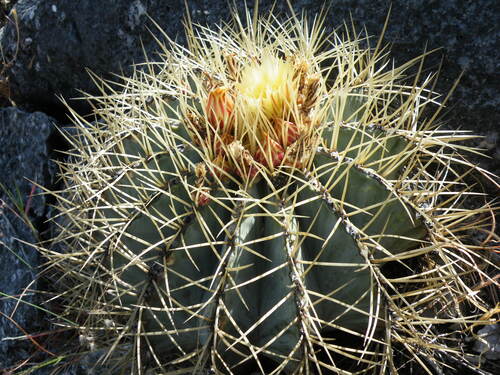
Sources differ in their descriptions, but distinguishing features include a globular to short-cylindrical stem with a conspicuous waxy blue-green to gray-green appearance, a slightly depressed apex, prominent sharp-edged ribs, and yellow spines; mature plants may produce basal offsets.
Photos


Sources
- GBIF Backbone: Ferocactus glaucescens (DC.) Britton & Rose — CC BY 4.0 · link
- Wikipedia (en): Ferocactus glaucescens — CC BY-SA 4.0 · link
- Wikipedia (de): Ferocactus glaucescens — CC BY-SA 4.0 · link
- Wikipedia (fr): Ferocactus glaucescens — CC BY-SA 4.0 · link
- Wikipedia (es): Ferocactus glaucescens — CC BY-SA 4.0 · link
- Wikipedia (pt): Ferocactus glaucescens — CC BY-SA 4.0 · link
- LLIFLE Encyclopedia of living forms: Ferocactus glaucescens — CC BY-SA · link
- Useful Tropical/Temperate Plants: Ferocactus glaucescens — CC BY-NC-SA 3.0 (facts only) · link
- RHS Plants: Ferocactus glaucescens — © RHS, facts only · link
- NC State Plant Toolbox: Bisnaga (genus-level) — copyright (facts only) · link
- Ferocactus glaucescens - Blue Barrel Cactus - Mountain Crest Gardens (mountaincrestgardens.com) — facts only (§12) · link