
Fennel (Foeniculum vulgare)
Foeniculum vulgare is an upright, aromatic, branching herbaceous plant. Sources differ in describing its life cycle: it ranges from biennial to perennial and is also commonly grown as an annual for food cultivation.
Overview
Foeniculum vulgare is an upright, aromatic, branching herbaceous plant. Sources differ in describing its life cycle: it ranges from biennial to perennial and is also commonly grown as an annual for food cultivation.
Origin and habitat
Sources differ on the native range: its core native area includes the Mediterranean region, while broader accounts extend through southern Europe, North Africa, and western Asia to Pakistan. It is commonly found in dry soils near coasts and along riverbanks and can also grow in dry, rocky, calcareous soils. It is adapted to Mediterranean-type to warm-temperate climates, is cold tolerant, and has become naturalized in many temperate or Mediterranean-type climate regions worldwide.
Characteristics
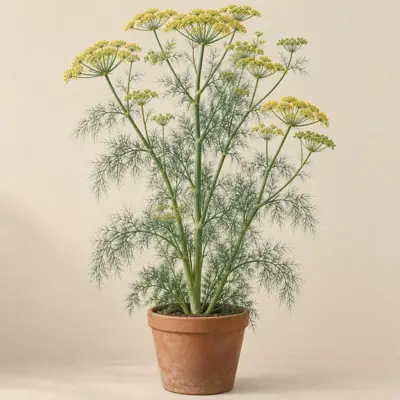
Sources differ on mature height, placing it at about 100–250 cm, while mature spread is 10–50 cm. The finely divided, feathery leaves have threadlike or needlelike terminal segments and sheathing leaf-stalk bases. Small yellow flowers form terminal compound umbels, with many small flowers in each inflorescence; sources differ on flowering season, describing it mainly as summer flowering but sometimes extending into early autumn depending on region or cultivation conditions. The dry, splitting fruit separates into segments when mature, has conspicuous longitudinal ribs or grooves, and commonly changes from green through yellowish brown and brown to darker colors.
Light
Foeniculum vulgare prefers full sun.
Watering
It prefers moist but well-drained soil and, once established, can tolerate drought and alternating dry and wet conditions.
Temperature and dormancy
It is frost hardy. It is generally reported to have an RHS H5 hardiness rating.
Growing medium and mounting
It is suited to well-drained clay, loam, sand, and chalky soils, with sources supporting acidic, neutral, or alkaline conditions.
Propagation
It is propagated by seed; sources differ in recommending direct sowing in spring or, in Taiwan cultivation guidance, sowing fresh seed after cooler autumn conditions begin.
Common problems
Wild plants can develop galls caused by gall midges; seeds can also be affected by gall midges, some orthopteran insects can lay eggs in stems, and butterfly larvae including swallowtails can feed on the leaves. Sources differ on its status, but it can readily self-seed, escape cultivation, and naturalize, becoming an invasive weed that forms dense stands in some regions. It tolerates cold and has some drought tolerance once established, but has difficulty surviving summer under Taiwan's humid and hot conditions.
Identification
Foeniculum vulgare is generally reported to have upright, hollow stems and an aromatic habit, with extremely fine, threadlike, feathery leaves and yellow compound umbels; it resembles dill in appearance but is usually taller.
Photos


Sources
- Wikipedia (en): Fennel — CC BY-SA 4.0 · link
- 維基百科:茴香 — CC BY-SA 4.0 · link
- Wikipedia (ja): ウイキョウ — CC BY-SA 4.0 · link
- Wikipedia (de): Fenchel — CC BY-SA 4.0 · link
- Wikipedia (fr): Fenouil commun — CC BY-SA 4.0 · link
- Wikipedia (es): Foeniculum vulgare — CC BY-SA 4.0 · link
- GBIF descriptions: Manual of the Alien Plants of Belgium; Database of Vascular Plants of Canada (VASCAN); Checklist of — per dataset · link
- NC State Plant Toolbox: Foeniculum vulgare — copyright (facts only) · link
- TaiCOL 臺灣物種名錄: Foeniculum vulgare — CC BY 4.0 · link
- 農業知識入口網 植物圖鑑: Foeniculum vulgare — © MOA, facts only · link
- Useful Tropical/Temperate Plants: Foeniculum vulgare — CC BY-NC-SA 3.0 (facts only) · link
- RHS Plants: Foeniculum vulgare — © RHS, facts only · link
- USDA PLANTS Database: Foeniculum vulgare — Public domain (US Government work) · link