
apple mint (Mentha suaveolens)
Mentha suaveolens is a perennial aromatic herb with an upright habit, rhizomes, and the ability to form runners or suckers, spreading outward into colonies.
Overview
Mentha suaveolens is a perennial aromatic herb with an upright habit, rhizomes, and the ability to form runners or suckers, spreading outward into colonies.
Origin and habitat
Sources differ on its native range: it is described as mainly native to Europe and extending into North Africa and southwestern Asia, with southern and western Europe and the Mediterranean region highlighted as important parts of its native range. It favors moist habitats and occurs near waterways, in ditches, wet grassland, damp roadsides, and places that may be seasonally flooded, although some native habitats may still be dry in summer. It is associated with temperate to Mediterranean environments in Europe, the Mediterranean region, and neighboring North Africa and southwestern Asia, and can also become naturalized in central and northern Europe.
Characteristics
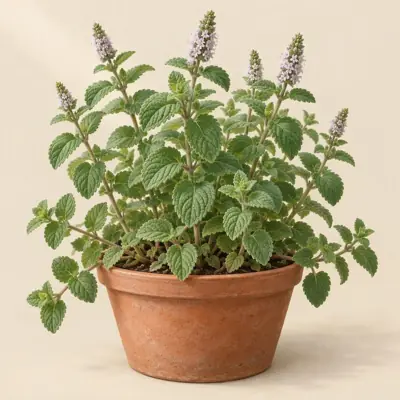
Sources differ on mature height, placing it at about 40–100 cm; a single source reports a mature spread of about 100–150 cm. It grows vigorously, with underground rhizomes or runners that can spread rapidly and may become aggressively spreading if unrestricted. The opposite, sessile, pale green to green leaves range from oblong and ovate to rounded-ovate, with a strongly wrinkled surface, toothed or rounded-toothed margins, hairs on the surface, often a downy underside, and an apple-like or mint-like aroma; small white to off-white, pink, or pale purple flowers are densely arranged in terminal spikes that may consist of multiple whorls. Flowering is mainly from mid-to-late summer into early autumn, and the fruit is reported to have small nutlet-like structures that are not constricted.
Light
It grows in full sun to partial sun, preferring a well-lit position while also tolerating bright partial shade.
Watering
Keep the soil moist but well drained and avoid prolonged dryness; in the wild it commonly occurs in moist habitats or near water.
Temperature and dormancy
It is reported to have an RHS H5 hardiness rating.
Growing medium and mounting
It adapts to a broad range of soils, including loam and heavy clay; in cultivation, moist, well-drained soil is preferred, with tolerance recorded for acidic, neutral, and alkaline pH.
Propagation
It can be sown in spring, propagated by dividing rhizomes during the growing season, or propagated from root-tip cuttings in spring; it also spreads naturally by rhizomes or runners.
Common problems
It is reported to be susceptible to green mint beetles and blue mint beetles. Its vigorous rhizomes and runners can spread excessively when planted in the ground and become difficult to manage; deep pots or containers can be used to restrict root spread.
Identification
Mentha suaveolens has strongly wrinkled, softly hairy leaves with an apple-like or fruity mint aroma, four-angled stems, underground rhizomes or runners that enable it to spread, and dense spike-like flower clusters at maturity.
Photos


Sources
- Wikipedia (en): Mentha suaveolens — CC BY-SA 4.0 · link
- 維基百科:蘋果薄荷 — CC BY-SA 4.0 · link
- Wikipedia (ja): マルバハッカ — CC BY-SA 4.0 · link
- Wikipedia (de): Rundblättrige Minze — CC BY-SA 4.0 · link
- Wikipedia (fr): Menthe odorante — CC BY-SA 4.0 · link
- Wikipedia (es): Mentha suaveolens — CC BY-SA 4.0 · link
- GBIF descriptions: Database of Vascular Plants of Canada (VASCAN); Lista de especies de plantas exóticas y trasplantada — per dataset · link
- Useful Tropical/Temperate Plants: Mentha suaveolens — CC BY-NC-SA 3.0 (facts only) · link
- RHS Plants: Mentha suaveolens — © RHS, facts only · link
- USDA PLANTS Database: Mentha suaveolens — Public domain (US Government work) · link