
sweet marjoram (Origanum majorana)
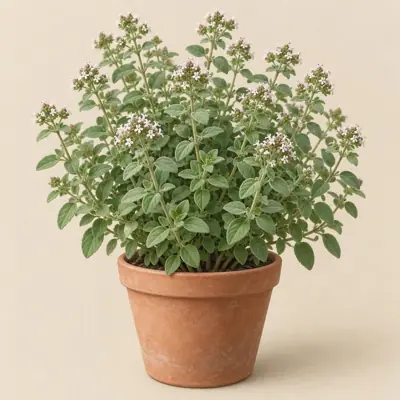
Origanum majorana is an upright herb to subshrub, often with soft hairs or a grayish-white covering of hairs. It is perennial, but because it does not tolerate cold, it is often grown as an annual in colder regions.
Overview
Origanum majorana is an upright herb to subshrub, often with soft hairs or a grayish-white covering of hairs. It is perennial, but because it does not tolerate cold, it is often grown as an annual in colder regions.
Origin and habitat
Sources differ on its native range: it is mainly placed from the eastern Mediterranean to western Asia, especially Cyprus and Turkey, while some accounts extend the range to the Mediterranean region, western Asia, the Arabian Peninsula, the Levant, North Africa, or parts of Europe. Natural habitats include dry slopes and rocky ground, and the plant is also widely cultivated in other regions. It prefers sunny, warm, relatively dry conditions and does not tolerate conditions that are both cold and wet.
Characteristics
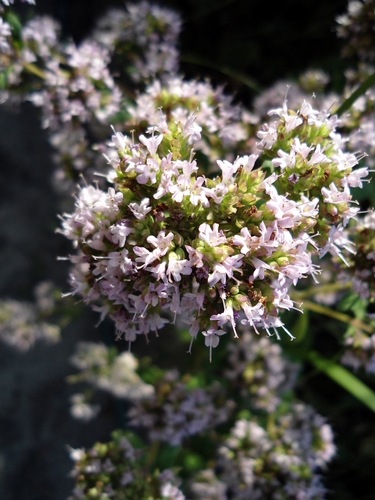
Sources differ on mature size, reporting a height of about 30–80 cm and a spread of about 10–61 cm. The aromatic, opposite, simple leaves are ovate to elongate-ovate or nearly round, with entire margins and often soft hairs that give them a gray-green to grayish-white appearance. Sources differ on flower color: the small flowers are typically white, with reports also describing pink, red, pale purple, or purple flowers, clustered at the tips or in dense inflorescences; flowering occurs in summer. The fruit is reported to form small, nearly spherical segments; another account describes small, round, reddish, nut-like fruitlets.
Light
Origanum majorana grows in full sun.
Watering
It suits relatively dry to moderately moist, well-drained soil, has good drought tolerance once established, and should not be kept overly wet in cold conditions.
Temperature and dormancy
Sources differ on cold hardiness, with some describing survival under particular colder conditions while another source says it is generally grown as an annual in colder regions.
Growing medium and mounting
It requires good drainage and suits relatively dry to moderately moist soil, preferring sandy loam but also growing in loam or calcareous soil; neutral to alkaline or slightly alkaline conditions are preferred.
Propagation
It can be propagated by seed or division; seed can be started indoors before the last spring frost or sown directly outdoors shortly before the last spring frost.
Common problems
Plants in this genus are reported to be rarely browsed by deer. Poor drainage and combined cold, wet conditions impair growth, and outdoor plants in cold regions may fail to overwinter. It is sensitive to cold; although it has good heat tolerance and drought tolerance once established, cold and wet conditions together are especially unfavorable.
Identification
The plant is aromatic, with densely soft-hairy leaves that feel soft and are often gray-green or grayish-white; compared with closely related oregano, sources describe its aroma as milder and more delicate.
Photos


Sources
- Wikipedia (en): Marjoram — CC BY-SA 4.0 · link
- 維基百科:墨角蘭 — CC BY-SA 4.0 · link
- Wikipedia (ja): マジョラム — CC BY-SA 4.0 · link
- Wikipedia (de): Majoran — CC BY-SA 4.0 · link
- Wikipedia (fr): Marjolaine — CC BY-SA 4.0 · link
- Wikipedia (es): Origanum majorana — CC BY-SA 4.0 · link
- GBIF descriptions: Catálogo de Plantas y Líquenes de Colombia; DAISIE - Inventory of alien invasive species in Europe; — per dataset · link
- NC State Plant Toolbox: Origanum majorana — copyright (facts only) · link
- Useful Tropical/Temperate Plants: Origanum majorana — CC BY-NC-SA 3.0 (facts only) · link
- RHS Plants: Origanum majorana — © RHS, facts only · link
- USDA PLANTS Database: Origanum majorana — Public domain (US Government work) · link