
garden thyme (Thymus vulgaris)
Thymus vulgaris is a perennial, evergreen, woody, much-branched small subshrub to dwarf shrub.
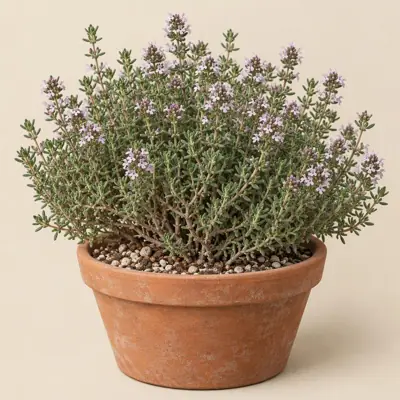
Overview
Thymus vulgaris is a perennial, evergreen, woody, much-branched small subshrub to dwarf shrub.
Origin and habitat
Sources differ on its native range, describing it as native to the Mediterranean region of southern Europe, with a core range from the western Mediterranean to Italy, including Spain, France, and Italy. Its natural habitats are mainly dry, sunny Mediterranean-type areas, including dry grassland, scrub, rocky slopes, and dry sandy, stony, or calcareous soils. It is reported to be adapted to warm, relatively dry conditions with hot summers and can grow in subtropical to temperate regions.
Characteristics
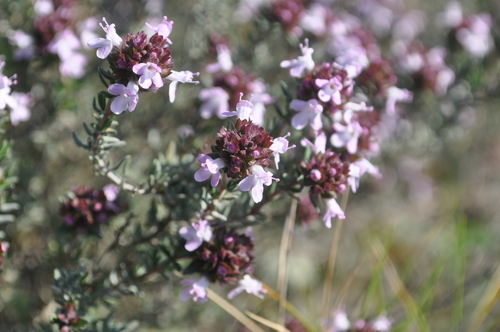
Sources differ on mature height, placing it at about 10–40 cm, while mature spread is 15–40 cm. The small, aromatic leaves are opposite and may be linear, narrowly elliptic, oblong, or lanceolate, often with downward-rolled margins; they range from dark green to gray-green, with the upper surface often gray-green and the lower surface whiter and sometimes hairy, and the petiole is extremely short or nearly absent. The small, two-lipped flowers occur in clustered whorls or terminal spike-like inflorescences and are commonly white, pink to reddish purple, or purple; sources differ on flowering time, describing it mainly from late spring to early summer, with some records extending into autumn. It is reported to form small, spherical nutlets.
Light
Thymus vulgaris grows in full sun.
Watering
It is relatively drought tolerant and suited to drier, well-drained conditions; avoid persistently wet soil, especially in winter.
Temperature and dormancy
A single source reports a lower temperature of about -15 °C; sources are few. It is reported to have an RHS H5 hardiness rating.
Growing medium and mounting
It suits well-drained sandy, stony, loamy, or chalky soils and prefers dry, relatively poor conditions; neutral to alkaline soil is preferred, and it is also commonly found in calcareous soils.
Propagation
It can be propagated by seed or vegetatively, including by stem cuttings, layering, or division; cuttings root readily, while seed germination may be uneven.
Common problems
It does not tolerate persistently wet soil, with excessive winter moisture particularly unfavorable, and propagation from seed can be more difficult because germination may be uneven. It is drought tolerant and has some frost tolerance, but drainage in cold conditions can affect its cold tolerance, especially where winter soils remain wet.
Identification
It is reported to form a low, dense plant with a pronounced aroma, a woody stem base, and many branches that may initially lie along the ground before rising obliquely or becoming upright; its small leaves often have rolled-under margins.
Photos


Sources
- Wikipedia (en): Thymus vulgaris — CC BY-SA 4.0 · link
- 維基百科:普通百里香 — CC BY-SA 4.0 · link
- Wikipedia (ja): タチジャコウソウ — CC BY-SA 4.0 · link
- Wikipedia (de): Echter Thymian — CC BY-SA 4.0 · link
- Wikipedia (fr): Thymus vulgaris — CC BY-SA 4.0 · link
- Wikipedia (es): Thymus vulgaris — CC BY-SA 4.0 · link
- GBIF descriptions: Manual of the Alien Plants of Belgium; Listado de especies de plantas útiles comercializadas en los — per dataset · link
- NC State Plant Toolbox: Thymus vulgaris — copyright (facts only) · link
- Useful Tropical/Temperate Plants: Thymus vulgaris — CC BY-NC-SA 3.0 (facts only) · link
- RHS Plants: Thymus vulgaris — © RHS, facts only · link
- USDA PLANTS Database: Thymus vulgaris — Public domain (US Government work) · link