
Horned Pansy (Viola cornuta)
Viola cornuta is a low-growing evergreen perennial herb with a clumping to spreading habit that can form ground cover, with stems that may creep or grow obliquely upward. It is a perennial herb but may also be grown horticulturally as an annual; sources describe this differently.
Overview
Viola cornuta is a low-growing evergreen perennial herb with a clumping to spreading habit that can form ground cover, with stems that may creep or grow obliquely upward. It is a perennial herb but may also be grown horticulturally as an annual; sources describe this differently.
Origin and habitat
Sources differ on its native range: the core distribution is given as the Pyrenees and the Cantabrian Mountains of northern Spain, while some accounts extend it to mountainous areas of southwestern Europe in France, Andorra, and Spain. It occurs mainly in montane to alpine and subalpine environments, including mountain meadows, pastures, grasslands, and rocky places. It is adapted to temperate and cool mountain environments; information from Taiwan describes it as preferring a cool climate and growing there mainly in winter and spring.
Characteristics
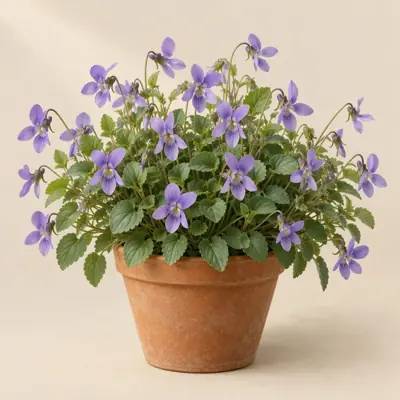
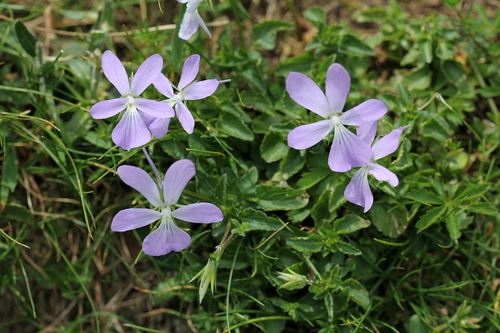
Sources differ on mature height, placing it at about 20–30 cm, while mature spread is 10–50 cm. Growth is reported to be rapid, and the green leaves are mainly ovate with crenate or shallowly crenate margins; some descriptions also note pointed tips, hairy undersides, rounder lower leaves, and more ovate upper leaves. The solitary, fragrant flowers have narrow petals and a conspicuous slender spur; the species is mainly purple, pale purple, or blue-purple, while horticultural varieties and hybrid lines include additional flower colors. Flowering varies markedly with climate, with European information describing flowering mainly from spring into summer and sometimes later, while cultivation information from Taiwan gives winter and spring as the main flowering period; the fruit is reported to be a blunt capsule that splits along seams when mature, with seeds that may be dispersed by ants.
Light
It grows in full sun to partial sun; insufficient light may lead to elongated, weak growth and reduced flowering.
Watering
Keep the soil moist but well drained, avoiding prolonged waterlogging or continual exposure to rain.
Temperature and dormancy
A single source reports a minimum temperature of about -15 °C, and the few available data give an ideal range of about 10–25 °C. A single source also reports a USDA hardiness classification.
Growing medium and mounting
It is suited to fertile, humus-rich soil that remains moist but drains well, including sandy, loamy, clay, or calcareous soils; information from Taiwan also recommends deep, fertile sandy soil. Some sources indicate that slightly acidic to approximately neutral soil is suitable and that excessively high pH may cause yellowing.
Propagation
It can be propagated by seed or by division in spring or autumn; information from Taiwan recommends sowing from autumn into winter.
Common problems
Possible pests include slugs, snails, aphids, greenhouse red spider mites, and violet gall midges. Reported diseases include powdery mildew, pansy leaf spot, viral disease, rust, and southern blight of herbaceous ornamentals; Puccinia violae is a known pathogenic fungus of Viola cornuta. Prolonged summer heat can reduce flowering, insufficient light can cause weak elongated growth and reduced flowering, prolonged rain can lead to petal rot or disease, and excessive warmth during sowing can impair germination. It prefers cool weather, with sustained heat suppressing flowering; it tolerates some cold, and some horticultural information also describes tolerance of brief frost.
Identification
Viola cornuta is reported to have narrow petals and a prominent slender floral spur, with the species bearing mainly purple or pale purple flowers; compared with common small-flowered pansy-type hybrids, its petals are narrower and its flower coloration is simpler.
Photos


Sources
- Wikipedia (en): Viola cornuta — CC BY-SA 4.0 · link
- 維基百科:角堇菜 — CC BY-SA 4.0 · link
- Wikipedia (de): Hornveilchen — CC BY-SA 4.0 · link
- Wikipedia (fr): Pensée à corne — CC BY-SA 4.0 · link
- Wikipedia (es): Viola cornuta — CC BY-SA 4.0 · link
- GBIF descriptions: Manual of the Alien Plants of Belgium; DAISIE - Inventory of alien invasive species in Europe; Globa — per dataset · link
- NC State Plant Toolbox: Viola cornuta — copyright (facts only) · link
- 農業知識入口網 植物圖鑑: Viola cornuta — © MOA, facts only · link
- Useful Tropical/Temperate Plants: Viola cornuta — CC BY-NC-SA 3.0 (facts only) · link
- RHS Plants: Viola cornuta — © RHS, facts only · link